


Between Uncertainty and Decisive Action: ESG Summit 2025 Advances Renewable Energy in Europe’s Commercial & Industrial Sector
Petersberg / Bonn, 1 December 2025
As part of the European Sustainability Week 2025, more than 500 representatives from business, politics, research and industry discussed current developments in ESG as well as sustainable energy and corporate strategies. The ESG Summit placed particular emphasis on the dynamic growth of renewable energy in the Commercial & Industrial (C&I) segment and its strategic importance for Europe.
Recent analyses show that Europe will install around 40 gigawatts of new photovoltaic capacity in 2025. A growing proportion of this is attributable to commercial and industrial applications. Several European markets are recording double-digit growth rates in the C&I segment. At the same time, the number of installed industrial storage systems is rising, now accounting for nearly a quarter of the total market. Companies are responding to increasing demands for security of supply, cost stability and sustainable operating models.
Guidance in the Industrial Transformation Process

The ESG Summit brought policymakers, technology providers and industrial end-users together, providing a platform to examine challenges and perspectives in the C&I segment from multiple viewpoints. It became clear that integrated energy systems – combining photovoltaics, battery energy storage solutions (BESS) and intelligent energy management – will need to be addressed more holistically in order to make industrial decarbonisation practically feasible.
The discussions highlighted that companies operating in industrial contexts increasingly require reliable analyses, realistic market assessments and comprehensible technical and regulatory evaluations. These foundations help organisations better assess investments and transformation processes, even amid economic and geopolitical uncertainty.
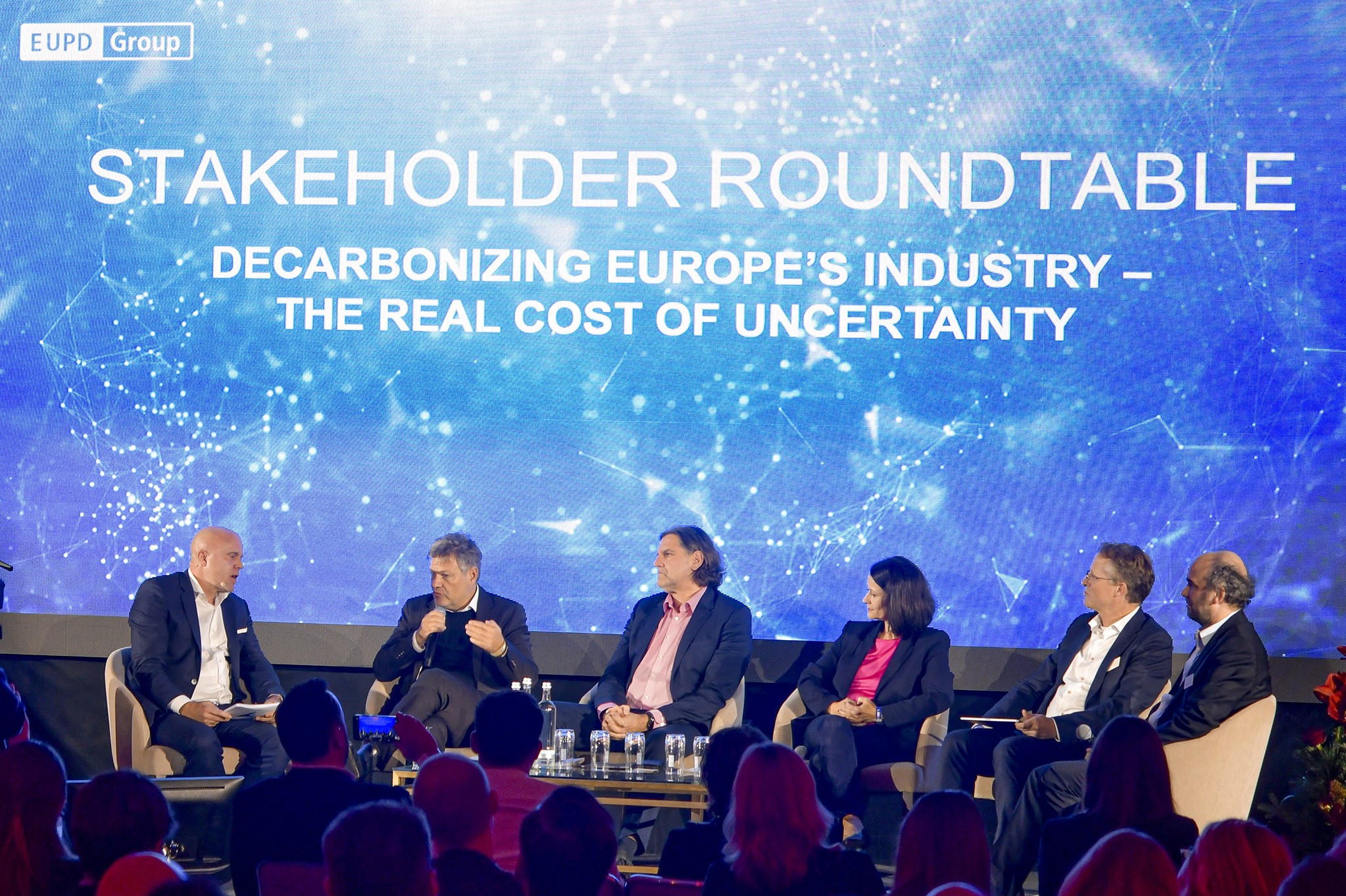
This was also emphasised by Melanie Kubin-Hardewig, VP Group Corporate Responsibility at Deutsche Telekom AG, during the panel discussion “Decarbonising Europe’s Industry – The Real Cost of Uncertainty.” She highlighted the gap between technological progress, appropriate market incentives and regulatory constraints: “In theory, an infrastructure like ours could make an even greater contribution to advancing green energy by deploying large-scale energy storage. We could produce more if both market incentives and regulation were structured in a way that allowed us to feed this energy back into the grid on attractive terms.”
Kubin-Hardewig also pointed to the existing potential of industrial energy storage systems: “We are currently scaling up to as much as 120 megawatts (…). We have plans to expand this significantly over the next two years – potentially to ten times that amount – if the incentives are right. This is a remarkable contribution for a single company. We are seeing that these storage capabilities help us become more independent, strengthen the resilience of our energy supply, and support us economically as well. Battery storage systems are already very cost-effective and are likely to become even more attractive in future.”
C&I as a Growing Field of Innovation
The increase in installed storage capacity – from around 20 to more than 35 gigawatt-hours within a single year – underscores the rapid pace at which the European market is developing. Requirements for system integration, safety and technological quality are rising accordingly.
Against this backdrop, EUPD presented awards such as the Top Innovation Award to future-oriented manufacturers and solution providers. These quality labels provide companies and investors with a solid basis for targeted, technology-open and risk-minimised investment decisions.
The participants reached a clear consensus on how to navigate global uncertainties: beyond overarching theoretical debates, it is the decisions within one’s own sphere of influence that matter most – this is where the necessary change begins. As Dr Robert Habeck, former German Vice Chancellor and Federal Minister for Economic Affairs and Climate Action, emphasised: “The real danger in decision-making is being afraid to make decisions. Everything we are able to decide, we could also decide more quickly. And yes, we may make mistakes. By ‘we’ I mean leaders, businesses, party chairs and governments. But if we do not overcome our tendency to avoid making decisions, then we are lost.”
In a market environment shaped globally by uncertainty and technological dynamism, independent market analyses are becoming increasingly important. They support manufacturers, EPCs, energy suppliers, investors, and industrial and commercial end-users in making well-informed decisions. For more than twenty years, EUPD Research has been providing data-driven insights into energy markets and sustainability strategies. This expertise also feeds into the design of the European Sustainability Week, which has developed into a central platform for exchange within the C&I segment.
Markus A. W. Hoehner, CEO and Founder of the EUPD Group, explains: “The European Sustainability Week aims to provide guidance in an environment undergoing major structural change. Our data and analyses, together with our extensive market access to relevant stakeholders, enable us to contextualise developments and, together with the community, actively shape the sustainable transformation of the European economy.”